Tallahassee, Florida / Since 2021
North Florida eats wood fences. We build for that.
Decay, termites and storm wind, all in the same back yard. Wood posts move under that. Steel doesn't. So every fence we build stands on galvanized steel posts, hangs on welded steel gate frames, and is set for the soil on your side of town. We won't be your cheapest quote. Seventy three people have rated us 5.0 anyway.
Why us
Six reasons people pick us over a cheaper quote
No jargon. This is the whole argument, and you can check every part of it against anyone else's quote.
- 01
Steel posts, not wooden ones
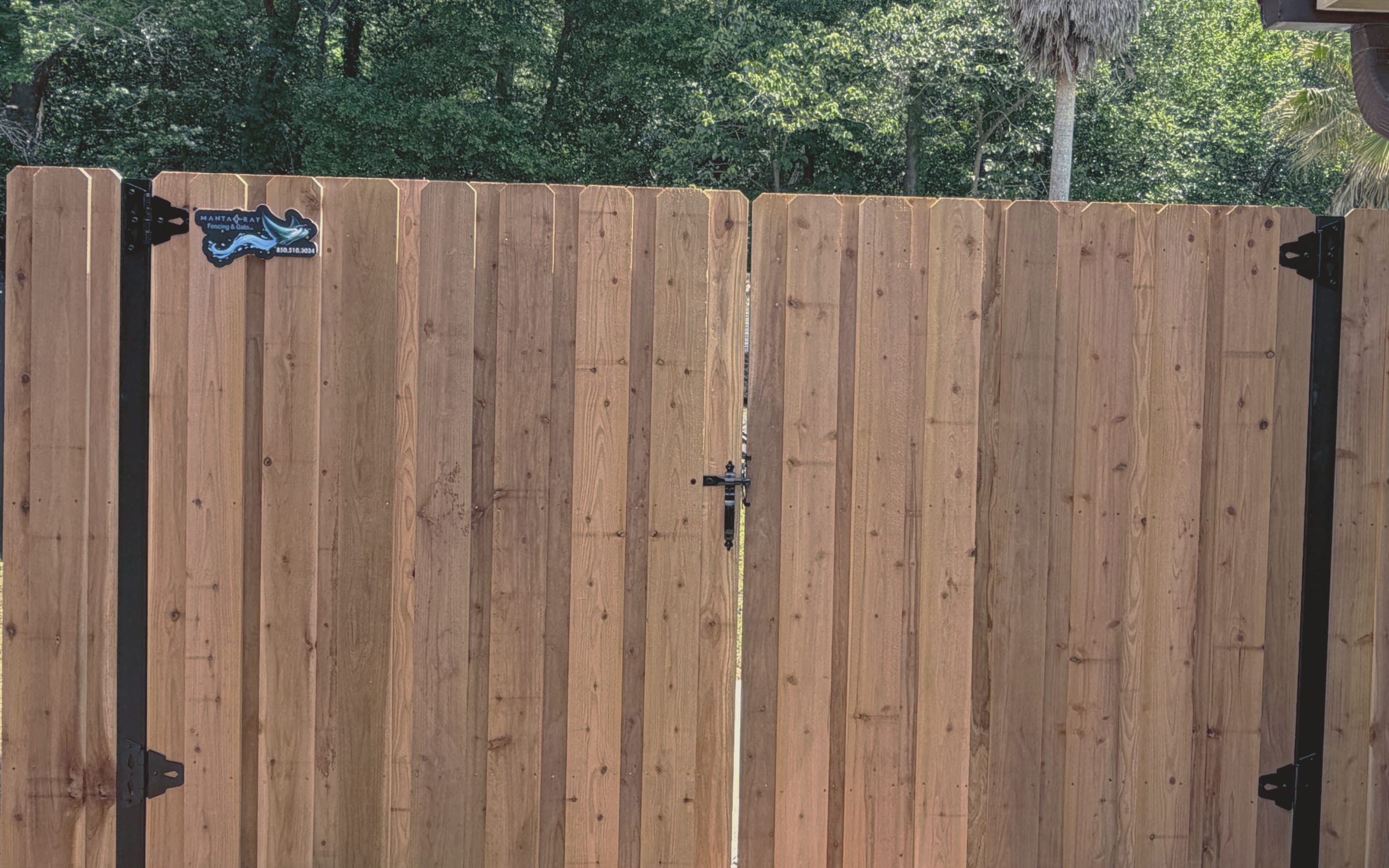
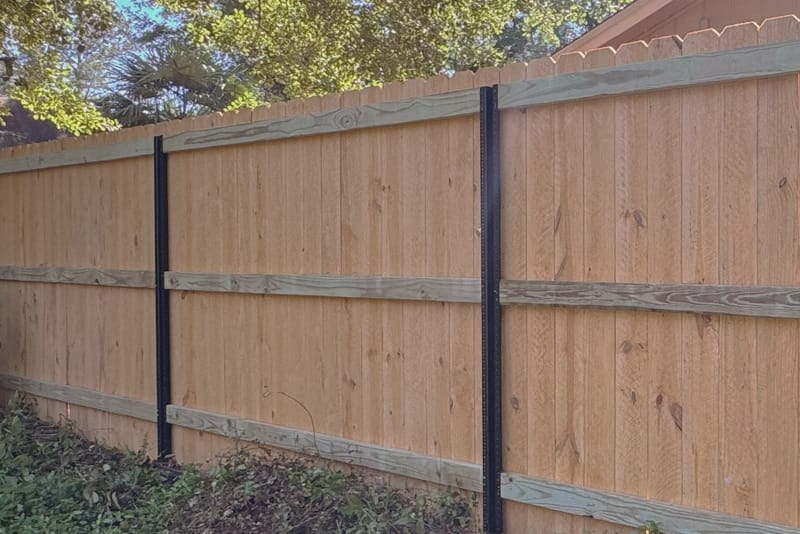
The posts are galvanized steel and they sit behind the boards, so it still looks like a wood fence from both sides. Wood posts twist and warp as they dry out. That is what makes a fence line go wavy. Steel does not move.
- 02
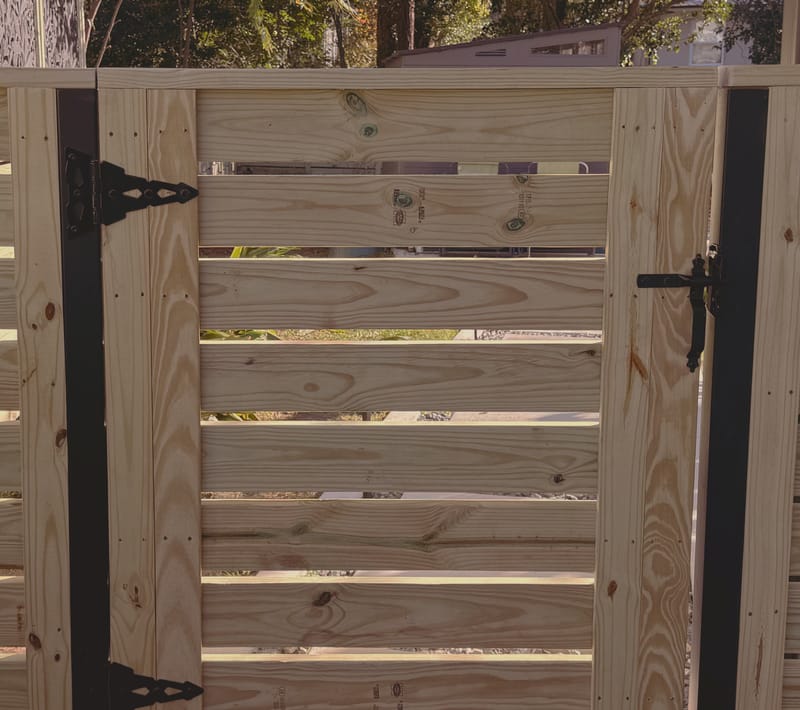
The gates are welded steel
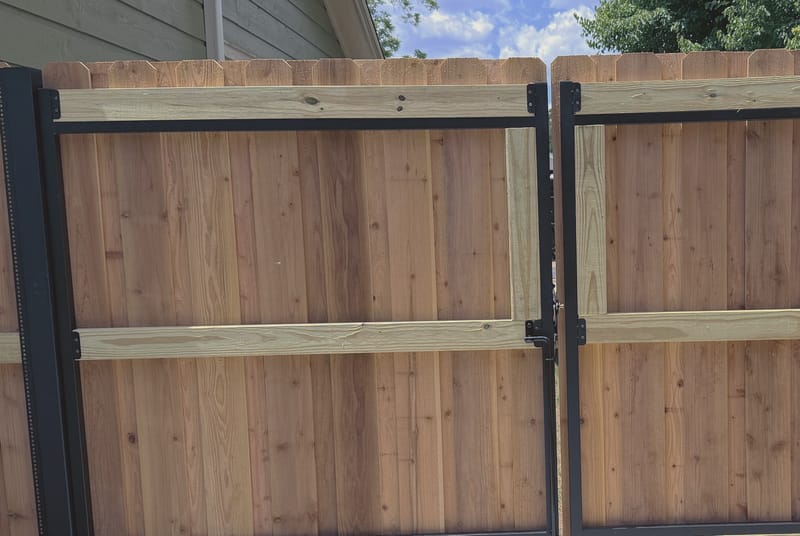
Gates fail first, because they are the only part that moves. A wooden gate frame slowly pulls out of square and starts to drag. A welded steel frame cannot, so it still latches years later.
- 03
The boards are stained before they are built
Stained at the factory, so every face and every cut end is covered before anything is nailed together. Water soaks into the end of a board about a hundred times faster than the side, and once a fence is up you can never reach those ends again.
- 04
Built for the ground you actually have
Tallahassee changes soil halfway across town. North of the Cody Escarpment is clay bearing loam. South is loose sand that drains fast and needs a deeper hole and a wider footing to hold the same post. We dig for the yard we are standing in.
- 05
You get the specification in writing
Materials by name, fastener type and grade, post spacing, concrete per post, gate locations, and photos of the style. You can hand our quote and anyone else’s to a third party and have them tell you which fence is actually better.
- 06
A date we can actually keep
We schedule five days for a three day job, which is why we are booking five to six weeks out. We could book two weeks out and turn up whenever. We would rather give you a real date and be there on it.
01 / The climate
The number nobody quoting you will mention
The USDA Forest Products Laboratory publishes a decay hazard index for every city in the country. It measures how fast untreated wood breaks down outdoors. Anything above 65 is considered severe.
And decay is only the first of three
Termites. The building code classifies all of Florida as a “Very Heavy” termite zone. That's the highest of four categories, and there isn't a county in the state that escapes it.
Storm wind. Tallahassee's adopted basic wind speed is 120 mph, 3 second gust, under the 2023 Florida Building Code. A six foot solid fence is a sail. Everything it catches goes into the posts.
Any one of those you can design around. All three at once is why a fence specified for a national market is not specified for this one. The materials that are fine in Denver or Los Angeles are the same materials, sold into a climate that treats them very differently.
02 / Straight answer
So does a wood fence just rot away here?
No, and we are not going to tell you it does. What actually goes wrong is quieter than that, and it is the reason fences here start looking tired years before they fall down.
The decay index and the termite zone are why the material has to be chosen carefully. Properly treated, ground contact rated pine handles both. Under-specify it and you have a problem. Specify it properly and you do not.
Pressure treated pine that's properly rated for ground contact is not going to rot out in five years. That's a myth. A ten year ground contact study in Gainesville scored treated southern pine 9.7 out of 10 for resistance to decay and termite attack.
What actually happens is the post moves. Treated southern yellow pine warps, twists, checks and splits as it dries. Read any treated lumber warranty and you'll find warping, twisting, checking and splitting are specifically excluded from coverage. So the post is still “good” by the warranty's definition while your gate drags on the ground and your fence line has gone wavy.
Steel doesn't move. That's the argument. It isn't more complicated than that.
What that's worth, in plain terms
A steel post outlives the boards on it. When the pickets and rails eventually weather, you replace pickets and rails and the posts stay in the ground. You are buying the expensive part once.
The part most people actually notice is simpler. A fence on posts that have not moved still reads as straight from the kerb. Ours are built so that in a few years they still look like they went in recently, rather than leaning, bowing and pulling away from the gate.
03 / Steel post vs 4x4
The same fence, on two different posts
A comparison of materials, not of companies. Both columns are published figures you can check.
Galvanized steel post
- Doesn't rot, twist, warp or crack. It's steel.
- 8.0 ft post spacing at every wind speed in the manufacturer's published table, from 70 mph through 110 mph.
- Installs behind the pickets, so the fence reads as wood from both sides.
- Limited lifetime warranty to the original residential purchaser. Replacement material, not labor, and coastal environments are excluded.
- When the pickets weather out, you replace pickets and rails. The posts stay.
4x4 southern yellow pine
- Warps, twists, checks and splits as it dries. That isn't a defect, it's what the material does.
- Spacing drops to 4.5 ft at 110 mph to carry the same six foot fence. Almost twice as many posts.
- Every treated lumber warranty in the industry specifically excludes warping, twisting, checking and splitting.
- UC4A is the general use rating and the usual big box stock. UC4B is the heavy duty rating, and it is rarely what's on the rack.
- When the post moves, the fence line moves with it.
| Maximum post spacing, 6 ft solid fence | 70 mph | 90 mph | 100 mph | 110 mph |
|---|---|---|---|---|
| Galvanized steel post | 8.0 ft | 8.0 ft | 8.0 ft | 8.0 ft |
| 4x4 southern yellow pine | 8.0 ft | 6.7 ft | 5.5 ft | 4.5 ft |
At the wind speeds this city actually designs for, a wood post fence needs its posts almost twice as close together to do the same job. Most of them aren't built that way.
04 / What we specify
Three decisions, made the same way every time
Galvanized steel posts.
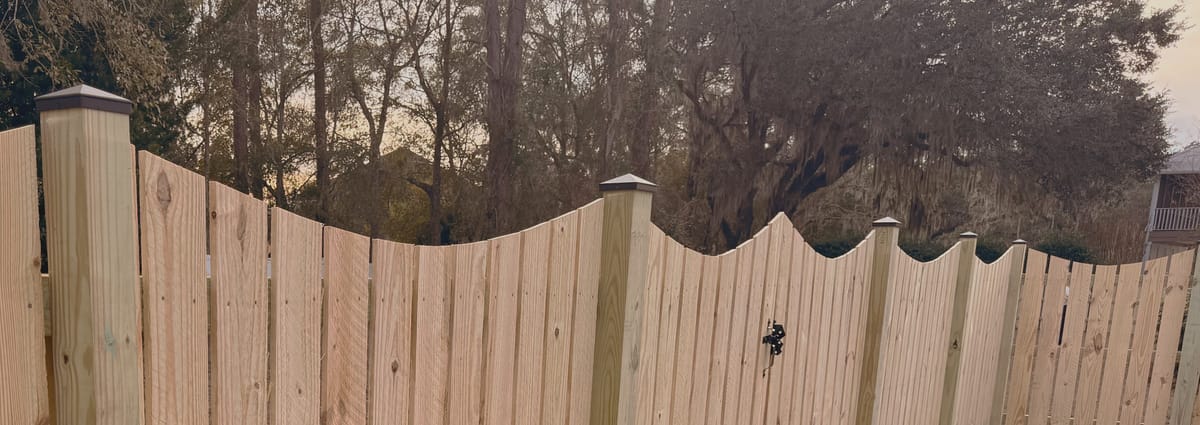
They install behind the pickets, so from either side you still see a wood fence. They don't rot, twist, warp or crack, and they carry a limited lifetime warranty from the manufacturer. When the pickets and rails eventually need replacing, you replace pickets and rails. The posts stay.
Welded steel gate frames.
Sixteen gauge, powder coated black. A wood gate frame sags. It's what wood does. A welded steel frame doesn't, so the gate still latches the way it did the day we hung it.
Pre-stained pickets.
Stained at the factory before assembly, which means every face and every end gets coverage. Water enters end grain about a hundred times faster than it enters the sides of a board, and end grain is exactly what you can't reach once a fence is built.
05 / In their words
Don’t take our word for it
Who actually does the work
He was quick to point out that he would be on site and doing the job himself with his team. I think that is what closed the deal for me. Having the owner of the company doing the work brings the process to a whole new level and you can see it in the craft.
On price
They will not be the cheapest fence company, but I truly believe you get what you pay for.
The finished work
The lines are clean, the alignment is precise, and the overall craftsmanship truly stands out. You can tell this fence was constructed to last.
Planning the line
You can tell he knows what he’s doing by how he planned it out and made suggestions about where to put the fence and how to get around trees.
Repeat work
We keep going back to Ray because we know he is a true professional who asks us what we want, gives us the options, adds his own thoughts and then creates a solid masterpiece, every time, all in the time frame that he promises us.
Turning up at all
I had tried for a couple of years to find somebody who would respond to my request for building a fence. Nobody wanted to follow through.
Scroll for more →
06 / Fit
We're not the right call for every job
Worth saying out loud before you spend an afternoon on estimates.
We're probably right for you if
- You're staying in the house, and you'd rather buy the fence once.
- You want the material list, the fastener type, the post spacing and the concrete per post written down before you agree to anything.
- You can wait five or six weeks for a date we'll actually keep.
- You care what's in the ground, not just what the fence looks like on the day it's finished.
- You've had a fence go wavy before and you don't want to do it twice.
We're probably not, if
- The lowest bid is what decides it. There are people here who'll do it cheaper, and that's a real option.
- You need it up next week.
- You want the cheapest thing that clears a survey before a sale.
- You'd rather not talk through soil, spacing and post depth. We're going to bring it up.
None of that is a judgement. It's just a different job than the one we're set up to do well.
07 / Questions
The things people actually ask
Why do wood fences here start leaning after a few years?
Because the post moves, not because it rots. Treated southern yellow pine warps, twists, checks and splits as it dries out, and once the post has moved the whole fence line follows it.
Read any treated lumber warranty and you will find warping, twisting, checking and splitting are specifically excluded from coverage. So the post can be entirely fine by the warranty’s definition while your gate drags and your fence line has gone wavy.
Does pressure treated wood really rot out in five years?
No. That is a myth and the field data does not support it. A ten year ground contact study in Gainesville scored treated southern pine 9.7 out of 10 for resistance to decay and termite attack.
We would rather tell you that than sell you something on a claim that is not true. The argument for steel is movement, not rot.
What makes Tallahassee harder on a fence than most places?
Two things, both measurable. The USDA Forest Products Laboratory puts Tallahassee’s decay hazard index at 93.6, one of the highest in the continental United States, where anything above 65 is already considered severe.
On top of that, the building code classifies all of Florida as a “Very Heavy” termite zone. That is the highest of four categories, and there is not a county in the state that escapes it.
How far apart should fence posts be?
It depends on the post. For a six foot solid fence, the manufacturer’s published data puts a galvanized steel post at 8.0 ft spacing all the way through 110 mph. A 4x4 southern yellow pine post drops to 4.5 ft at that same speed.
Tallahassee’s adopted basic wind speed is 120 mph, 3 second gust, under the 2023 Florida Building Code. At the speeds this city actually designs for, a wood post fence needs its posts almost twice as close together to do the same job.
Why does my gate sag when the rest of the fence is fine?
A wood gate frame is a rectangle held together at the corners, hung off one edge and swung several thousand times a year. Over time the corners work loose and the rectangle becomes a parallelogram. That is the sag.
It is not bad building, it is geometry plus weather. We build gate frames from 16 gauge welded steel, powder coated black, so the frame cannot rack in the first place.
What is UC4A and UC4B, and why should I care?
They are the two ground contact ratings for treated lumber. UC4A is the general use rating and it is what covers fence posts. UC4B is the heavy duty rating, specified for severe decay environments and for members that are difficult to replace.
In a city with a 93.6 decay index, UC4B is the defensible specification. It is also rarely what is sitting on the rack at a big box store, which is worth knowing when you are comparing two quotes that look the same on paper.
Why are you booking five to six weeks out?
Because we schedule five days for a three day job. We would rather have the room and not need it than promise you a date we cannot keep.
We could book two weeks out, take your deposit, and then turn up whenever. We would rather give you a date that is real and then be there on it.
Do you set posts in concrete?
Yes, and the concrete is crowned, sloped so water sheds away from the post rather than pooling against it. That is the documented best practice, despite what you will read in contractor forums.
Depth and footing width vary by where you are in town. Tallahassee is split by the Cody Escarpment: north of it you are in Orangeburg fine sandy loam, and south of it you are into Ortega and Kershaw sands, which are loose and drain fast. Loose sand needs deeper embedment and a wider footing to develop the same resistance.
08 / Services
What we build
Custom fencing
Slopes, trees, awkward corners, and two soils across one town.
View 02Pool fencing
Code compliant barriers, self closing and self latching gates.
View 03Chain link fence repair
Storm damage, leaning posts, gates that no longer close.
View 04Wood privacy fences
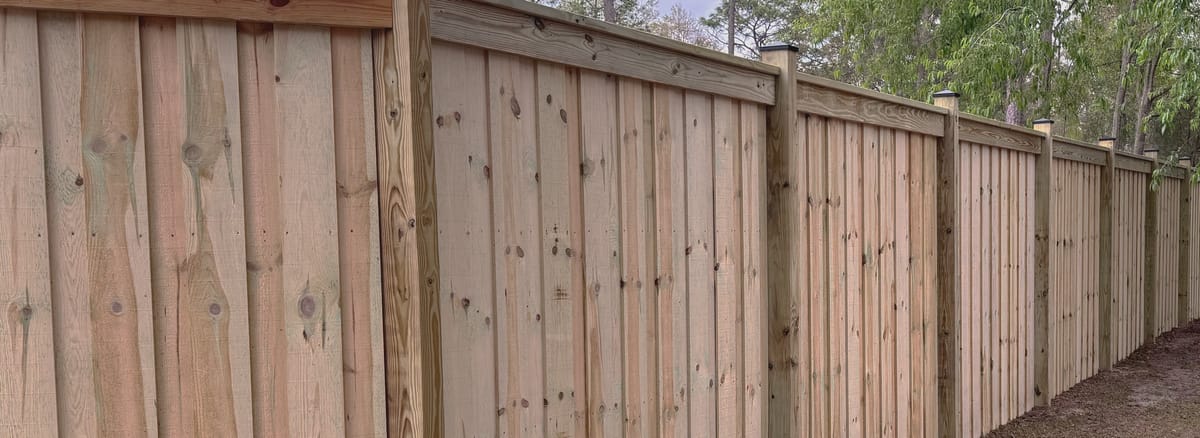
Board on board, shadowbox, dog ear. Steel posts standard.
View 05Aluminum and ornamental
Including pool code compliant enclosures.
View 06Gates
Welded steel frames, commercial grade hardware.
View 07Farm and ranch fencing
Field fence, no climb, split rail, entry gates.
View09 / Service area
Where we work
Tallahassee and the surrounding area, including Killearn, Buck Lake, Golden Eagle, SouthWood, Bull Run and Ox Bottom. We also work in Wakulla, Gadsden and Jefferson counties.
If you're not sure whether you're inside that, call and ask. It takes a minute to find out.
Ready for a real quote?
Tell us what you're thinking about and we'll come walk the property. No pressure, no same day close, no “this price is only good today.”