Specification
How we build
Most fence companies will tell you they use quality materials. Almost none of them will tell you which ones. Here's ours, in detail, so you can compare it against anyone else's quote.
The posts
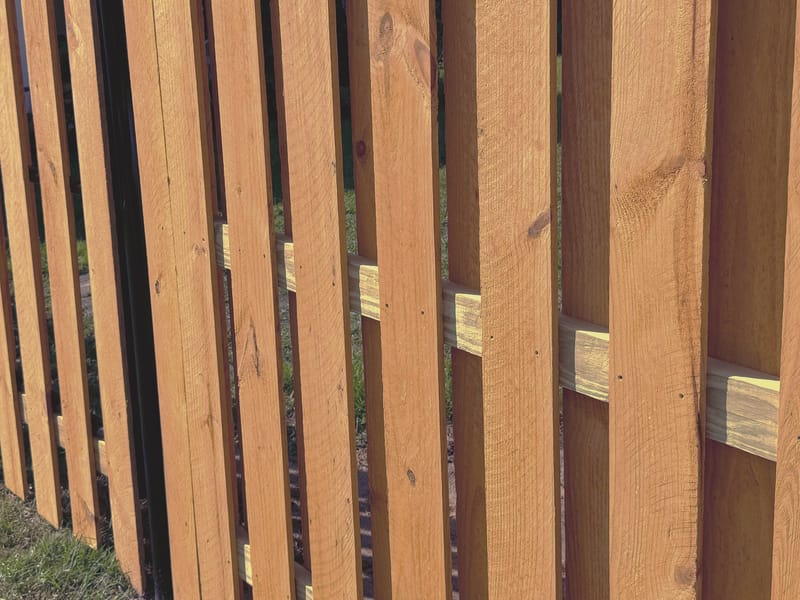
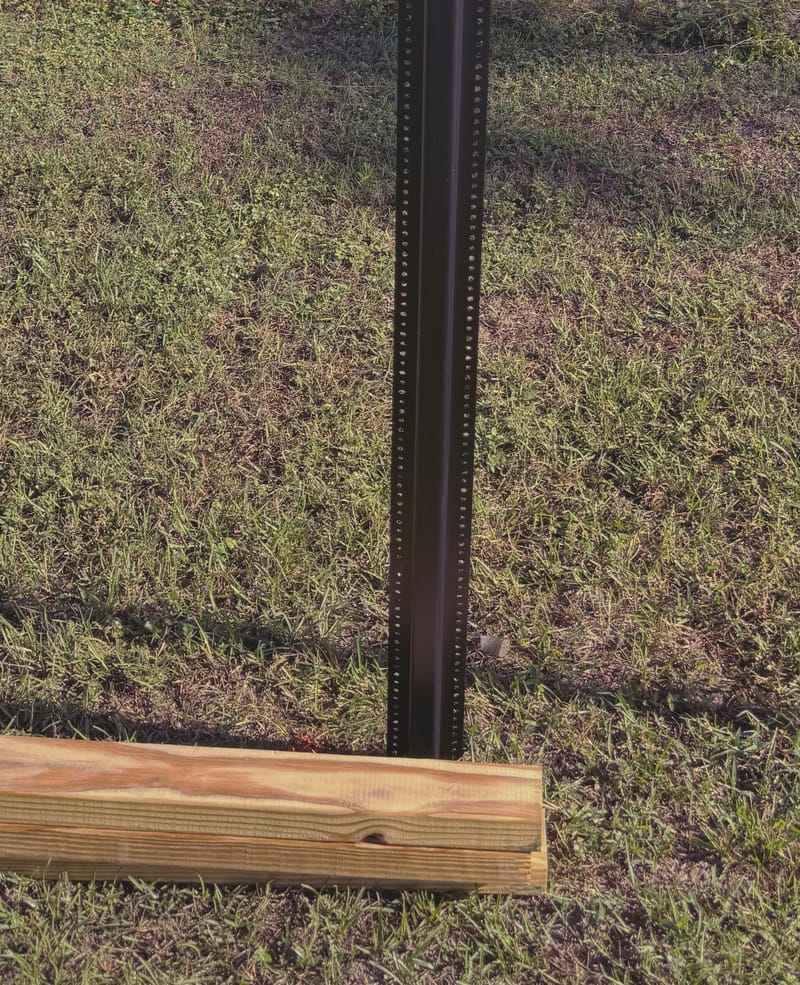
We use galvanized steel posts from Master Halco on every privacy fence. They're designed to sit behind the pickets, so the finished fence reads as wood from both sides. You never have to decide which neighbor gets the pretty side.
Specification
| Material | Galvanized steel, G90 zinc coating, ASTM A653 |
|---|---|
| Yield strength | 50,000 psi |
| Embedment | 36 inches in firm undisturbed soil |
| Warranty | Limited lifetime to the original residential purchaser |
About that warranty, stated honestly. It's a limited lifetime warranty, not an unlimited one. It covers the original residential purchaser, it isn't transferable, and it covers replacement material rather than labor. It excludes coastal and marine environments, wind damage above 73 mph, and surface rust, which the manufacturer treats as a natural characteristic rather than a defect. We'd rather you hear that from us than find it later.
The gates
Gates are where most fences fail first, because a gate is the only part that moves.
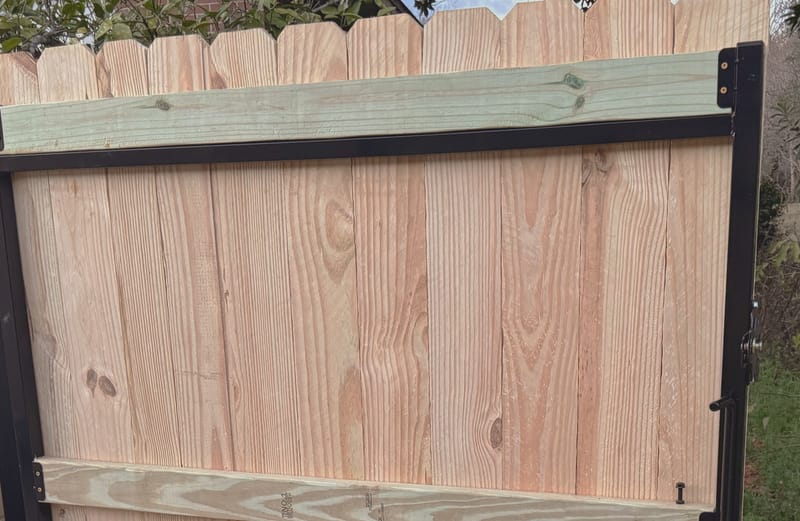
We use 16 gauge welded steel gate frames, powder coated black, on steel gate posts. A wood gate frame racks and sags over time. That's not poor building, it's just what a wood rectangle does when you hang it off one side and swing it a few thousand times. A welded steel frame doesn't rack, so when the pickets eventually weather out, you replace pickets on the same frame.
Hardware is commercial grade, not the hinge and latch set that comes bagged with a gate kit. That's most of the reason ours still swing true after a few thousand cycles.
The pickets
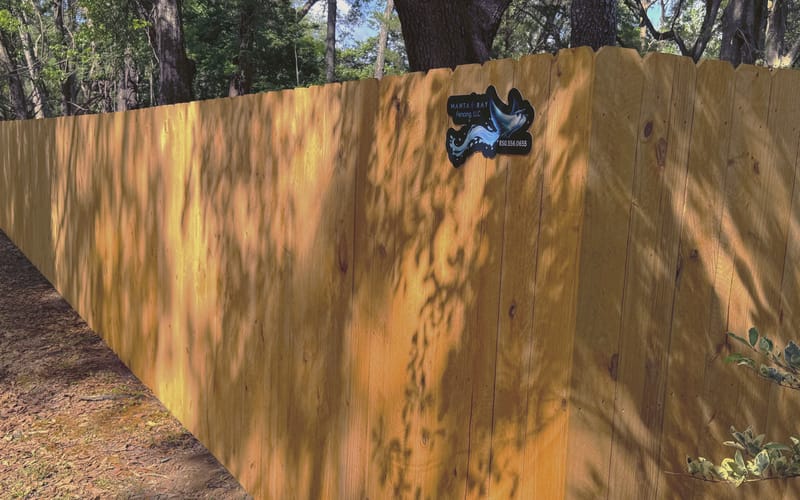
Pre-stained at the factory before assembly. Two reasons this beats staining on site:
Every face gets coverage, including the end grain and the back side, before anything is nailed together. Once a fence is built, those surfaces are unreachable. The Forest Products Laboratory calls end grain sealing “probably the single most valuable improvement that can be made in standard construction practice,” because water enters end grain roughly a hundred times faster than it enters the face of a board.
And it isn't weather dependent. Site staining needs a dry window and a dry substrate. Factory staining doesn't care what the forecast says.
To be clear about what pre-staining does and doesn't do: it's a better finish, applied more completely. The rot and termite protection comes from the pressure treatment, not the stain. Color will still need refreshing eventually, like any exterior finish.
Setting posts
Posts are set in concrete and the concrete is crowned, sloped so water sheds away from the post rather than pooling against it. That's the documented best practice and it's what the research supports, despite what you'll read in contractor forums.
Depth and footing width vary by where you are in town, which is something almost nobody accounts for locally. Tallahassee is split by the Cody Escarpment, an ancient shoreline. North of it, through Killearn, Ox Bottom, Bull Run and Golden Eagle, you're in Orangeburg fine sandy loam. It's the red-orange clay bearing soil, and it drains at an intermediate rate. South of it, toward SouthWood and Woodville, you're into Ortega and Kershaw sands, which are loose and drain fast. Loose sand needs deeper embedment and a wider footing to develop the same resistance.
Wood, honestly
We're not going to tell you a treated 4x4 falls over in three years. It doesn't, and the field testing is clear about that. A ten year ground contact study in Gainesville scored treated southern pine 9.7 out of 10 for resistance to decay and termite attack.
The problem with wood posts isn't that they rot out. It's that they move.
Treated pine warps, twists, checks and splits as it dries out. Every treated lumber warranty in the industry specifically excludes those things. So you can have a post that's fully covered by its warranty and completely fine by the manufacturer's definition, while your gate drags and your fence line looks wrong.
One more thing worth knowing if you're comparing quotes. Ground contact lumber comes in two grades. UC4A is the general use rating and it's what covers fence posts. UC4B is the heavy duty rating, specified for severe decay environments and for members that are difficult to replace. In a city with a 93.6 decay index, UC4B is the defensible specification. It's also rarely what's sitting on the rack at a big box store.
What you get in writing
Every quote includes the exact fence style and height, the material list by name, fastener type and grade, post spacing, concrete volume per post, gate locations and swing, and photographs of the style you're considering.
You should be able to hand our quote and anyone else's to a third party and have them tell you which fence is actually better. That's the point of writing them that way.
Ready for a real quote?
Tell us what you're thinking about and we'll come walk the property. No pressure, no same day close, no “this price is only good today.”